Saturday

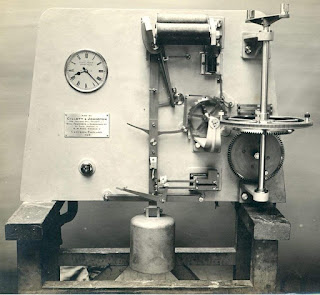
Original Gents' WT Drawings

*
I found these drawings on my hard drive. No recollection of where they originated. These images have been downsized and their contrast boosted to suit the blog format.


I do have a set of full size drawings but they are far too large to scan easily.


Click on any image for an enlargement
*

Sunday

Photobucket WT album!

*
While running a thorough Google search for <pulsynetic> I was delighted to find the following album in Photobucket:

http://s626.photobucket.com/albums/tt344/jjjjsmith317/Lafayette%20IN%20Gents%20Pulsynetic%20Clock%20movement/

A C40B(?) Waiting train installation and beautifully photographed! This WT  resides in Lafayette, Indiana in the USA. I finally found it on Google Earth next to the Shell gas station.


The clock dials on their own cupola. Sitting on a lantern on the roof a commercial building. The WT lives right up in there with leading-off roads going straight to the motionwork behind each of the dials. The opal glass and attractive cast iron dials are no doubt backlit at night. One wonders how accessible the movement is to visitors. The roof looks as if it is covered in shingles. 


A beautifully sharp image of the WT movement! Probably quite early judging from the black finish on rather slender castings. Later WT movements look relatively massive and robust in comparison.

The lacquered brass parts and electromagnets are all early. The WT technique has obviously been standardised here. Though there are detail differences in the design of many of the parts. The cranked, Hipp toggle damper hangs unused just above the rocking armature to the left of the drive electromagnets. 

The hand setting dial is engraved with the original patents. Surely another early detail? Later dials just have "Pulsynetic". There is a strangely later feature in the contact steady bars being pressed rather than cast. They have also had to be heavily bent upwards to reach the Hipp toggle. Perhaps a replacement? The lack of adjustment in the base may have needed this degree of bending. Though the Hipp toggle does look rather short.

The supporting brackets for some of the parts have no slots for adjustment. The Hipp toggle and contact supports were provided with slots in later WT movements.


A close up of the large, pendulum drive electromagnets. They look quite similar to my own coils except for the brown colour and lack of thick wax. They would have been subject to bright sunshine for decades. Which may have bleached the green. My Synchronome has exactly the same bleaching problem. The rocking armature and pendulum impulse pallet are well seen here. Note the oiler on top of the cast brass(or bronze) armature bearing. The neat little dial pointer is present just below the dial. This would be used for setting the clock hands to time. Useful for summer and winter time changes.


The usual WT detail is rather more slender than I am used to seeing on later WTs. Not exactly conclusive but perhaps suggesting the 1920s?  The photographer has done a great job of catching all the detail despite the potential for glare from the dials in the background. There is no hand setting crank on the ratchet/worm shaft. It may have been lost over the years. I find it exceedingly useful for re-setting the time. 

Cast dial centre, 12:1 motionwork and sturdy expansion coupling with leading-off rod going back to the WT off the left side of the picture. The heavy steel frame seems like overkill but may be supporting the iron dial frame against wind loading.

Detail seen through the WT's cast frame showing modern wiring. Perhaps a replacement power supply to match modern wiring codes and practice? Two very different transformers are present.I was trying to make the orange 'hats' into diodes. The transformers may actually be related to the lighting system for the translucent dials.

The two hex heads on the right of the picture are the bolts holding the lower pendulum rod and attached bob to the upper section. Separation here made transport and movement for maintenance of the WT movement much easier. The bob being very heavy and unable to be removed easily at the top. Though the sealed bearing support cases can be unbolted and lifted away. This may seriously risk the safety of the upper components attached to the pendulum rod. There was always the problem of the slot in the support bench. The gathering pallet and Hipp toggle would not pass through the slot if the pendulum was detached at the top. By placing a suitable support under the bob the two bolts can be easily undone. Leaving the relatively light upper section to hang freely from its pivot bearings.


A serious amount of metalwork supporting another set of motionwork. The slotted expansion/universal coupling is in the foreground. This would allow for variations in alignment between the WT movement and dial. The leading off rods expand and shrink with changing temperature. So the slots allow for this too. These couplings are standard features on most turret clocks. They allow for considerable building movement without binding. Many leading off systems are far longer than in this very compact WT installation.

Click on any image for an enlargement.
*

Friday

Another WT on YouTube

*
While searching for "Pulsynetic" I found another YouTube video of a larger WT. Possibly a C40B.

It follows the same practice as the smaller C40A but is scaled up to drive and control the hands of larger dials. The top of the cast main frame is arched with vertical members on each side. Making it an attractive and balanced design. The Hipp toggle damper now rises from the armature pivot casting. The contact assembly has pressed steady bars from the post war period. While the finish is the earlier black with lacquered brasswork. The time setting dial is present and much larger than those of the C40As. The drive electromagnets look like bare, enamelled copper wire. The video poster suggests it is running on 20VDC. I thought I had seen a table somewhere showing 30V for the B model. It may be a false memory.


It is a great shame that the video background is so busy. But much worse, the camera is being blinded by the glare from the windows behind the WT. One couldn't ask for more difficult filming conditions! The video claims to be 720p HD but sadly it doesn't look it for the reasons given above.

This is not petty criticism for its own sake. Nor some peculiar artistic snobbery on my part. I simply wish to be able to examine this very rare movement in much greater detail. To make valid comparisons with my own movement and all the other material available online and in print.

A published video is not just moving pictures. It is a unique historical record of a piece of technology, in action, on a certain date. Making a visual recording bears a certain amount of responsibility to future study. And yes, I do know that my own efforts are hardly inspiring. Nor do they set the pinnacle of creative video making. That said, they do show all the details reasonably sharply given my limited skills, lack of practice and rather humble equipment. So that a later researcher can identify exactly how the item works and the methods used.

This is not some wishful thinking on my part. Committing a video or photograph to the internet will probably provide an indelible record far into the future. When the item has been lost to the ravages of time, the video or photograph will be the only remaining record of a unique device. One can never tell how such information will be used in the distant future. Students of the future may trawl their own internet like historians and archaeologists search papers, church records and libraries today.

The irony is that future historians may well be far more interested in the background activities and clothing than the WT. Perhaps they will have the skills to 3D print any object which ever existed. Though they may need our help to do so. By our providing enough detail for their advanced technology to maximise our efforts.

Today, we can automatically improve our digital photographs. This, only a few short years after its invention. Tomorrow's technology may be able to rebuild literally anything from scratch. All at relatively low cost.

Perhaps fully realistic moving holograms will be more desirable and collect less dust? A future horologist may easily have a fully lifelike C40B WT clonking away in his study. One which he can walk through as he crosses the room. He may even smile to himself as he walks around it. Fully aware that it does not exist in reality. Happy to pretend that it does. As some private joke.

Few can predict the future. The absence of obvious time travellers could suggest it is truly impossible. Or that there are no time travellers. Simply because man ceased to exist. A year, or three, into our own future.

*

Saturday

Another C40A WT on eBay Feb 2012

"This movement was rescued from a school undergoing demolition in 2006. 
The age of the movement is not certain but the school was opened in 1951. 
It seems likely that this was installed at that time.  
 This item is in West Yorkshire, pick up only and cash on collection.

If you have any questions please contact by email  jim@steward13.freeserve.co.uk
Thank you for looking."


A rare and desirable item has come up for auction on eBay: 
A small, Gents Waiting Train movement with original, oak support bench. 

 I have brightened, cropped and sharpened the seller's original images in PhotoFiltre.

A slightly later movement but still with the soft curve to the main casting above the drive electromagnets. This form dated back several decades to the original design. Even later movements have a diagonal section in place of this curve in the main casting. 

All later movements used plating in place of the earlier clear lacquer to the bright metal parts. (brass or bronze) This was probably to increase the longevity of the movement and bring a more modern "industrialised" appearance. One which did not date or deteriorate rapidly.

It must be remembered that the vast majority of WTs were humble, timekeeping workhorses. Hidden away from public view. They supplied a reliable time service with little need for maintenance. Nor did they need to be wound! This allowed them to be placed in very inaccessible positions. Post-war electrical equipment became uniformly grey in appearance. 

Some WTs were used as a driving force (motor) for very slow moving displays or equipment. The WT was only very rarely on public view. Or even visible to the owner. Most were probably housed under a simple, wooden box cover in an attic. Or high in the side of a building, chimney or tower.

This particular example is very complete and in seemingly, very good condition. Only the small, time-setting crank is missing from the front end of the worm/ratchet wheel shaft. Easily re-made and certainly not vital to the running of the movement. Examples of the small crank and handle may be copied from images elsewhere in this blog. 

Full crown wheel and bevel gear cluster are present at the rear. So four dial potential if desired. This would usually mean raising the movement to the level of the dials. Unless a great many, extra, bevel gears were used. It can of course drive fewer dials. Or none at all. Relying on the hand setting dial for timekeeping in a collector's home. 

This one (the dial) needs cleaning and possibly re-silvering. Do not use abrasives or metal polish to clean the dial! The engraving must remain undamaged. A competent, antique clock repairer can re-silver the dial if necessary. Just ensure they aren't the sort of ham-fisted butcher who uses coarse sandpaper to "clean" the surface first! They should be asked to match the original grain and its texture but only if it absolutely necessary to re-grain the dial. Don't take the dial anywhere near a high street jewellers! Most haven't a clue about restoring antique clocks let alone dials. 

It seems a shame if a WT does not drive the hands of even a modest dial. Fibreglass dial replicas and reproduction hands are all readily available in a wide range of sizes. There is no need to wait for an original, vintage dial and hands to come up for sale. A dial can be applied to a gable end, barn, stable or workshop to taste. Or even mounted on a wall indoors as part of an active WT display.

The Hipp Toggle damper, relay eccentric stop, hand setting dial and its pointer are all present and correct. All very desirable and difficult to reproduce well.

No obvious signs of rusting or damage. The movement should clean up very easily if the coils are carefully protected from serious wetting. They are bandaged and varnished anyway but it would probably not pay to immerse them completely. All screws should have a high quality penetrating oil applied well before any attempt to loosen them. Not WD40! Which is highly toxic and a poor substitute for real penetrating oil.

Do not use powerful solvents to clean the movement. They are completely unnecessary. A cloth, toothbrush or paintbrush and washing up liquid in warm water may be all that is required. Rubber gloves and protective goggles are very desirable.

I carefully dismantled my own movement and used odourless paraffin. (Oil lamp fuel) Turpentine substitute would do just as well. (domestic oil-based paint thinners) Followed by a careful wash in washing up liquid, in warm water, to aid drying. Paper towels to finish. This extra work was necessary to remove old oil stains. While they may be part of the history of the movement I preferred a slightly cleaner look for the living room. 


When or if dismantling a WT, very great care is required in handling the very heavy drive coils and their very thin and very fragile, copper wire tails. If you break a wire tail it can be a complete disaster! Requiring a full coil rewind! You have been warned!

A short, accurately timed, impulse at 1/2 minute intervals will be required to trigger the Waiting Train mechanism to keep good time. This is usually provided by a Gents Pulsynetic master clock. Without a master clock impulse every half minute the movement will run foolishly fast. Simply because it does not pause for several seconds at each half minute. (The Movement is not called a "Waiting Train" for nothing) 

There are a lot of half minutes in a day and they all add up! 2880 to be exact. Multiply by (say) a 2 seconds pause = 5760 seconds/60 (minutes). Which means a WT, without a controlling master clock, will run at least 96 minutes fast per day!  This seems rather unlikely and I have never checked if this is true. Nevertheless a WT was never intended as an accurate timepiece. It is really just a powerful, slowly rotating electric motor with external speed control.

A 2 rpm synchronous motor with a projecting pin actuating a micro-switch could be substituted for a master clock. Though a matching Gents Pulsynetic master clock is much more desirable to the collector. These master clocks can often be found on eBay(UK). There seems to be no shortage of these rugged and reliable master clocks. Only the early ones seem to attract collectors and higher prices at the moment. The usual Pulsynetic clocks are very affordable indeed. Though they can be a bit noisy for a quiet home. Don't confuse the Pulsynetic with a PO36 master clock. The latter won't provide the ideal short, clean 1/2 minute pulse. Even though they were often made by Gents. (amongst others) 

Normally, a closed wooden box would protect the WT movement from the curious, damage, bird droppings, water and dust. The battens around the bench top would locate this box. A collector would probably want to see and enjoy the movement while it is working. An inverted aquarium, of rather unusual proportions, might suit. With polished edges a glass box might be made quite attractive with very careful use of clear silicone. Some aquaria shops offer a made-to-measure service. I should  emphasise that there is no need to use so much silicone when it is not necessary to resist water pressure!

Suitably thick, clear polycarbonate, or perspex, can be cemented, folded, or even heat welded very neatly, by an expert. Again the edges would need to be polished first to achieve a neat finish. Reasonably thick glass resting on felt would block more noise than plastic due to its much greater mass. Though a holes (or holes) would be necessary to drive the hands of a dial.  

These movements are quite noisy when they send the 20 Volt pendulum drive pulse to the big electromagnet coils. The armature makes quite a loud clunk but usually only at (around) 1 minute intervals. So may not make an ideal domestic pet in a shared household with an unsympathetic partner. 

Though there are simple methods to help reduce noise. Soft dampers on the coil faces and reducing the voltage slightly will help. The constant rattle of the Hipp toggle can be a distraction or soothing depending on the listener. The sheer power and weight of the moving parts of these movements do not make ideal decoration for a home with small children! Fingers could be very easily crushed by the massive, swinging pendulum! As could those of a careless adult! So use reasonable care when the movement is running.

Oil all the obvious pivots (including the rear inaccessible ones with a drop of oil on a needle tip) with turret clock oil. Easily available on eBay(UK). Or just use bicycle oil for a movement which is well cared for in a clean, domestic setting. Wipe away any excess oil with a tissue.

The suspension bearings should be re-greased. Though this would require the bearing cover plates to be removed from the top casting. If the old grease is found to be hardened it should be flushed out with a solvent/degreaser. Then replaced with a modern, quality grease. Use a good quality, well fitting screwdriver to remove any screws but only if really necessary. Damaging the screw slots is considered bad form and reduces the value and originality of the movement. Original BA screws are very hard to find these days of metric mediocrity and uniformity. 


Note: The WT movement runs on 20 Volts DC

Plug-in power supplies for these DC voltages are readily available. Charity shops are sometimes an excellent source. Many of these outlets have a box or two of these "Wallwarts" offering a whole variety of voltages. Both DC and AC. Good eyesight, or a lens, may help in deciphering the small text usually printed on the applied label.

A WT movement should never be connected directly to the mains electricity! Not only would lethal voltages appear on naked metal parts but the coils would be severely damaged! Probably leading to a fire!


The auction closed on £1,230 reserve not met!  Ouch!

Slow at first, the bids were coming thick and fast at the very end. Now I suppose it will have to be auctioned all over again! Will they drop the reserve or will the auction start again from £1230? The high bidder must have been very disappointed they did not reach the reserve. The reserve may only have been £1250 for a "round" figure. (only a wild guess) If so, the seller might come to an agreement with the highest bidder to avoid another auction at escalated prices.

With these unusual movements it pays (?) to be generous with one's high bid and hope it is enough. Over the long term a couple of hundred pounds is neither here nor there. Not when one can have a WT movement to enjoy for years to come. It's never about an item's absolute value. Winning is all that really matters in the end. You can either afford an item or you can't. 

So few WT's appear on eBay that it is difficult to able to set an average value. There just isn't enough data to see any useful pattern. With an original clock bench provided this lot must surely have been well worth having. Just for the pleasure of cleaning and restoration of both items. I really thought it would go much higher. The difficulty may have been the stipulation of pick-up only. Though that's hardly a major hurdle when a courier will pick up, pack and deliver. Albeit at further expense, of course. 


Click on any image for an enlargement.
*

Tuesday

WT C40A on eBay

*


An early, Gents' Pulsynetic WT, in a rather sorry state, has turned up on eBay. The pictures are almost as poor as the condition of the early movement. I have enlarged them considerably and played with contrast and gamma for posting here.

The armature impulse hook is pre-roller suggesting a very early example of the small WT. Certainly pre-WW2 and perhaps even 1920s. The black, cotton (or silk) wrapped, insulated copper wire on the electromagnet bobbins is early too. (Though the wire insulating wrapping may have been dyed green originally) The relay electromagnet's bearing plate is diagonal and has chamfered ends. (though not easy to see here)

The original black (semi-matt) paint on the mainframe is an early indication. As is the rounded "knee" to the cast main frame above the drive electromagnets. The contact assembly support post is oval, fixed and horizontal in the major axis. Even slightly later iterations of the WT have a slotted support base and a taller vertical axis with radiused ends.  All these details point to confirmation of its authenticity as a very early C40A WT movement.

Sadly the movement is still too distant to make out any real detail in the auction images. Enlarging even the original images just makes them fuzzy.

It looks as if the gathering pawl is absent but I can't be absolutely sure. It may still be attached to the pendulum top. Though it looks considerably slimmer than on later models.

It looks as if all the bevel gear cluster is missing at the rear. The usual casting to support the bevel wheels is present but there are no bevel wheels present. Nor their stub axle block. Not in any of these images. Though the wormwheel shaft must be present because a leading-off coupling is visible at the left of the movement. So at least you have a drive to one or two dials.

The worm could be badly rusted but it is impossible to see such fine detail from these images.The Hipp toggle and contacts are thankfully present. As is the WT relay coil and mechanism. The wiring almost certainly needs sympathetic replacement. It should run happily on 20 Volts DC when it is finally restored. You will also need a master clock, of course. These WT movements don't keep time (at all) without a master clock to give a correcting impulse at half minute intervals.


General view. The pendulum is present with top bearings still attached. Hopefully, that may well be the gathering pawl still attached to the pendulum too. (hanging at 45 degrees or 20-to-two) Though it is very difficult to confirm this from the image. The gathering pallet is a complex brass or bronze casting and not at all easy to reproduce without a machine shop. It straddles the pendulum rod and is also pivoted there. So this may have saved it from becoming lost. If only the images were better with decent close-ups!

This is very definitely not a restoration project for a complete beginner. Dismantling a rusty movement can easily damage vital parts. Clamping the movement in the vice would be cruelty beyond belief! Clearing vital threads in rusty holes requires the correct tools (taps) and some manual skill. 

If screws are rusted in (and they very probably are in this case) then you can't just spray WD40 all over the place. It is a poor substance to use for this purpose anyway and highly toxic to some people. If I get so much as a whiff of it (even out of doors) I am ill for days! 

There are much better (proper) penetrating fluids used by car mechanics and restorers. Browsing will throw up suggestions which may be locally available. 

Patience is absolutely essential to allow the fluid to penetrate the rusty thread around the firmly stuck screws. There is very little room and the thread's normal air space is full of binding rust! Apply the proper penetrating fluid to all the screws at least a week before you even think about removing any of them. The longer your leave the fluid the better the chance of success. And, the least chance of a disaster! 

Many of the fixing screws are cheese head, slot-head steel. Requiring the slot be cleaned carefully before a perfectly fitting, straight bladed screwdriver, of high quality, is applied. A worn or tapered screwdriver point will ruin your chances of removing the screw. A screwdriver which fits perfectly wíll seem almost too big but must reach to the bottom the slot in the screw head to ensure maximum turning force can be applied. Buy a brand new, quality screwdriver with a good handle for applying plenty of torque. 

Cheap, or discount, tools will not have the highest quality steel of the best tools. Some Chinese tools are even made of mild steel! Which is absolutely hopeless. I have seen such screwdrivers take on a twist after a short period of use. Stanley used to be a name to trust but the last cross-head screwdriver I bought crumbled on the very first screw. Another Stanley cross-head screwdriver, which I bought well over four decades ago still works as if it were brand new.

Try screwing  gently inwards before outwards. Try tapping the screw head with a very small hammer to break any remaining hold the rust may have on the screw threads. If the screw will not turn then apply more penetrating fluid and try again after a few days. Heat is sometimes suggested but may ruin the original paintwork. Unless you use a powerful soldering iron rested on the head of the screw.  

Attempting to unscrew a rusted-in screw may snap it off right inside the casting. Now what? You will have to carefully centre punch the broken screw very accurately. Then drill it out a concentric hole with increasingly, larger drills. Without damaging the original thread in the casting. Now you have to remove the thin, tubular shell of the weakened carcase of the screw. A reverse threaded conical stud extractor helps here. Then you have to clean the rust out of the threaded hole with the correct tap. Without making the screw hole too loose for a new screw. No easy task! 

If you haven't worked on old cars, old motorcycles or rusty bikes then don't start practising on an early Gents' Waiting Train. A tin of 3-in-1 oil and a pair of old pliers isn't going to get you anywhere! You may damage the movement beyond economical repair. Great patience is required in such a project or you may ruin the original finish on parts. Or break them while trying to slide rusty shafts through bronze bearings. The rust must be carefully removed first. If you think that rust removal involves a spinning wire brush in an electric drill then you may be in for a shock when it comes to valuing your finished project.


Plenty of motion work here! Leading-off rods and contrate gears. (A simpler form of bevel gear) The four sets of motion work have minute hand counterbalance weights. Condition mainly rusty and corroded. Most of it looks as if it has all been standing in the rain for years!

The pendulum impulse coil bobbins look as if they have disintegrated. This requires real skill and patience to fix properly. Because it probably means making completely new bobbins and a complete coil rewind. If you want to retain any semblance of originality you can't just rewind the coils with new enamelled copper wire. It will look completely incongruous! Greatly reducing the value of the movement. The coils will be by far the most difficult part of the restoration. Probably requiring a decent lathe at the very least. It may be just possible to glue turned new bobbin ends to the original cores without disturbing the windings. Though it would require considerable luck and skill. 


Another view showing partially dismantled movement and all the dial work. One dial hour pipe (in the foreground) is rusted right away! As it came from a stately home the turret clock system may have been abandoned at some point in its history. It could be somewhere around 90-years old by now.

As so few of these WT movements come up on eBay it is very tempting to bid with your heart instead of your head. You may be desperately hoping the poor condition means it will be more affordable.  I would suggest that, unless you have the proper skills, or know a man who does, you leave this one well alone. It would be better to save up and buy one in much better condition. Knowing what is involved I would hesitate to take this one on myself.

I hope the auction winner has the skills to sympathetically return this movement to its former glory. It is almost certainly the earliest WT I have seen in this size. If its installation history can be confirmed it will almost certainly add to the pleasure of ownership.


The auction ended on £1420 GBP.

Click on any image for an enlargement. Back click to return to the text.

*

Thursday

Centenary of the Royal Liver Building WT

*
 
This blog chapter is in celebration of the centenary of the Royal Liver Building WT clock installation. Not to mention the timely publication of Colin Reynolds' fascinating record of its construction. These were the largest electrically driven clock dials in the world when installed in 1911. Colin Reynolds' book covers the story of its construction from within the Gent company. With many unique, original illustrations and photographs from the time. Bringing the entire clock installation to life despite the intervening century.

 Colin Reynolds' excellent book detailing the construction and installation is available from Formby-clocks or from Reprint.

Books on Church or Turret clocks - Jeffrey Formby Antiques

The Great George Liver Clock : Reprint

Gent enjoyed considerable, global publicity from the prestige of providing such a record breaking installation. Particularly for their newsworthy meal for 40 dignitaries around one of the completed dials. This led to WTs, for public dials, being sold right around the world. No doubt the sales of their impulse clocks systems increased as a result. WTs could be added to any impulse clock system. Often without the necessity for the special architectural details always needed by weight driven clocks. Not least finding room for the weight chutes.


This image was taken from an old book on aspects of electrical engineering. 
I scanned the illustration into my computer and then lightened it and improved contrast in PhotoFiltre.

The WT was a truly revolutionary public clock movement. Providing a compact, reliable and incredibly accurate performance independent of weather conditions. Moreover it did not need arduous, regular winding or bulky weight shafts to house massive weights. Nor was it subject to the wear and breakdowns to which the far more complex, weight driven clocks were prone. Thanks to its relative simplicity a WT did not require a skilled turret clock maker to maintain it. This made it particularly attractive in undeveloped countries. Even haphazard mains electricity supplies were no real hindrance. Because the impulse clock systems and WT movement usually ran on trickle-charged batteries. Allowing the WT system to cope with power cuts.

Click on any image for an enlargement. Back click to return to the text.


Four, highly exposed, 25' dials are mounted 220' above the ground on two towers of the Royal Liver Friendly Society building in Liverpool. Three dials are mounted on one tower facing the sea and up and down the Mersey. With a fourth dial on another tower facing the city. The hands on each dial are driven by a single, large, Gents' Waiting Train movement. (tower image borrowed from Wikipedia)  A Liver Bird surmounts each tower like a perfectly proportioned clock finial.

Royal Liver Building - Wikipedia, the free encyclopedia

These large WT movements were designed and hand built specifically to drive the hands of these enormous dials. Bigger, even, than the dials of the Westminster Clock which strikes the hours on Big Ben. The loads were made worse, on the Liverpool clock dials, by their exposure to Atlantic gales. Loads on exposed clock hands increase as the cube of wind velocity.

No practical mechanical clock could ever cope with such a task. Many unique problems were overcome in the manufacture and supply of the complete clock installation including the dials.

Accuracy, reliability and long life were essential. The WT is renowned for its accuracy under the most appalling weather conditions. Being also, and quite uniquely for a turret clock, as accurate as the master clock which controls it. With enormous reserves of torque to cope with icing and fierce, storm force winds on the giant hands.


Here is a view of just one of the four WT movements and the dial motionwork beyond. They are each mounted in separate, glazed, iron framed cases. These keep the mechanisms clean and avoids accidents to the unwary. The cases also provides unprecedented visibility of the clockwork mechanisms for visitors.

A view behind one of the 25'6" diameter, iron and opal glass, skeleton dials. The hour pipe can be seen supported on a massive cantilevered bracket. Due to the enormous loads, on the slowly rotating components, Gent's engineers came up with a unique system of rollers. The hour pipe itself is supported and restrained against lifting by three outboard rollers. The minute arbor is itself supported on rollers attached to the hour pipe. The huge bracket, cantilevered off the building's masonry, supports the roller bearings for the clock hands close behind the dial.

The darker roller assembly can be seen at the centre of the huge dial in the image above. Plain bearings would have had far too much friction and potential corrosion problems over time. Particularly in a maritime environment. While the rollers have provided reliable, low fiction bearings for 100 years.

The many tie rods and turn-buckles can be seen holding the cast framework of the huge dials onto the inner masonry of the tower. Lighting is provided so that the dials can be seen and read from a great distance at night. This stand-off dial design allows the tower to be closed behind the dial. Otherwise a huge hole would have been necessary right through each face of the tower to allow the dials to be evenly lit at night.

A general view of one of the WT movements. The large electromagnets (protectively wrapped in red) provide the driving impulse to the massive pendulum. The electromagnets are switched on via a Hipp toggle and electrical contacts. Smaller electromagnets lock the electrical contacts closed to provide an extended impulse. At the end of the swing a pin on the crutch unlocks the contacts again.

The main frame is diagonally braced against twisting. Resisting the reaction forces of the giant wormwheel as it drives the exposed hands. Frame bracing, in depth, is provided for the massive pendulum. A brass, hand setting dial is provided on the free end of the wormwheel shaft. The, long, bright steel, horizontal shaft near the bottom of the movement frame is the worm arbor (or shaft).

A close-up of the Hipp toggle and block. Instead of a single Hipp V-block a multi-toothed rack is provided here. Perhaps as extra insurance against slipping or missed impulses. It may also allow a smaller pendulum arc for emergencies in very bad weather. 

The freely pivoted, Hipp toggle (hanging from its bracket at top left)  looks no different from that on my own relatively tiny WT. Almost hidden below the Hipp block and contacts are the contact locking electromagnets. Also wrapped in red, protective material. Just like the larger drive electromagnets. The Hipp toggle and its block form a simple, but totally reliable, electro-mechanical switch. Together, these apparently simple components constantly monitor the pendulum arc. Only giving a drive boost (via the large drive electromagnets) if the pendulum arc falls below the set limit.

Normally the toggle rattles freely back and forth across its block. Only when the pendulum swing drops low enough will the toggle catch in the block on the return swing. The toggle then depresses the block and firmly closes the attached electrical contacts. Electricity flows through the large drive electromagnets. Giving the pendulum a really strong push.

If the clock hands are struggling to overcome heavy winds the pendulum swing will drop more quickly due to the extra energy demanded. The toggle will close the contacts as often as required to maintain the pendulum's minimum arc. As often as every other swing if necessary. 

So many extra drive impulses provide a massive increase in power and torque to drive the hands in poor weather conditions. When the storm has passed the toggle senses the lighter load and the impulses become very much less frequent. It was the combination of Hipp toggle and the (completely automatic) variable frequency of drive impulsing which made the WT so utterly reliable. Many weight driven clocks would run slow or even stop in very bad weather. 

To the right of the toggle is the (black) pendulum impulse hook cast onto the crutch. The impulse from a roller takes place on top rather than underneath the hook. (the latter usually occurs on the smaller WTs) This detail is rather difficult to see because of the enclosing casting.


The WT movement with the large, 30-tooth ratchet wheel in the foreground. The ratchet wheel converts the oscillating motion of the pendulum into rotational movement. On smaller WTs the ratchet wheel has only half as many teeth as the Liver clock movements. Presumably the engineers decided that a larger wheel would need huge teeth if limited to only 15 teeth. Which could not possibly be gathered securely by the pawl. Not unless the ratchet wheel and its pawl were placed very low on the pendulum rod. (or on a much longer crutch) 

Having two, D-shaped, lifting pins on a much larger ratchet wheel, with finer teeth, satisfied several vital geometrical requirements. The finite swing of the pendulum and the distance down from the pivot bearings provides a strictly limited stroke. The Liver movement ratchet wheel makes one complete rotation in slightly less than one minute. The teeth are large enough to be physically reliable. Without requiring an excessive swing of the pendulum to gather its teeth. Most of the critical components on the WT are made of gun metal. A tough, hard, wear and salt resistant bronze. Brass would corrode over time.

Beyond the ratchet wheel, on the same shaft, is the worm. The worm and its matching wormwheel must provide a 60:1 reduction in rotational speed and a similar increase in torque. The bottom half of the wormwheel is seen edge-on near centre top of the image above. Presumably it uses a double start worm to achieve a 60:1 reduction from the worm shaft. The wormwheel must rotate once per hour to provide the minute hand drive without extra complication in the motionwork gear ratios.

Note the heavy thrust bearings to resist the severe end-loads on the worm. The worm not only drives its wormwheel against the loads on the giant clock hands outside the building. It also locks the hands safely against any unwanted movement. Perhaps due to ice imbalances, flocks of birds on the clock hands or wind loading. Backlash would be very undesirable because it would show timekeeping inaccuracies on the minute hands of each separate dial.

Interestingly, it was the inability to limit variations between dials which excluded the use of four separate weight driven, turret clock movements. Gents were able to offer a guarantee that all the dials would show the same time thanks to their master clock control. The contract to build the Liver Clock installation stipulated 2 seconds per week accuracy. Few turret clocks can manage this.

Detail of the pendulum support bearings. A fine ratchet wheel is provided on the end of the bearing support shaft. This provides slow rotation of the bearings to avoid flat spots on the bearing races. The loads on the pendulum bearings are always predominantly downwards.

On smaller WTs a hand wheel is provided, just here, to allow random rotation of the ball races. Presumably the friction would be too great in a WT of this massive scale to turn a knob by hand. The Gent engineers have cleverly provide auto-rotation. So nobody needs to worry about forgetting to turn the knob at intervals.

Pendulum top and bearing assembly from the other side. The cylindrical, black-painted counterweight of the gathering pawl and the pawl bearing can be seen centre right. The black bar hanging almost against the main frame is the pendulum crutch. Oiler caps can be seen on the pendulum bearings. The fine ratchet wheel (bearing rotator) is well seen here. The bearing shaft, ratchet pawl is rocked between adjustable stops by the swinging pendulum.


Here I have labelled the major components of a Liver WT movement. (Just in case you have become lost in my wordy descriptions) Click the image to enlarge it for greater detail. Back click to return to the text.

BTW: I have used both ratchet and gathering wheel interchangeably for the same component.

The "WT magnet" labelled on the left is a small "relay" electromagnet. (Wrapped in black) Connected in series with the master clock it releases the (momentarily locked) WT drive to the hands once every half minute. The rest of the time the hands advance perfectly normally.

This incredibly simple mechanism, is used in a design of pure electro-mechanical genius. It forces the giant hands of the dial to follow the master clock exactly. Maintaining an accuracy to within a couple of seconds per week. The pendulum becomes a powerful and totally reliable electric motor. The WT mechanism harnesses this enormous power to keep perfect time.

The actual Waiting Train mechanism in close-up. The 30 tooth ratchet wheel is pulled around by the swinging pendulum via the gathering pawl. (the black horizontal lever in the centre of the image) Twice every revolution of the ratchet wheel one of two D-shaped pins lifts the L-shaped lever. This lever is counterbalanced and pivoted in the relay electromagnet pivot plates on the left. A backstop (lever) resting in the teeth of the ratchet wheel stops the gathering wheel from turning backwards.

Driven by the gathering pawl, the L-shaped lever lifts until it has been locked by a step in the relay electromagnet's armature. Now the gathering pawl can no longer reach the teeth of the wheel. A forward projecting pin, on the pawl, slides freely back and forth on top of the L-shaped lever. (without the pawl able to gather more teeth on the ratchet wheel)

Moments later the short electrical impulse comes through from the master clock. The armature is instantly attracted to the relay electromagnet core. Releasing the L-shaped lever. The L-shaped lever drops. The gathering pawl can now drop back into the teeth of the ratchet wheel and immediately starts driving the hands normally. The short pause in drive to the hands goes completely unnoticed by anybody viewing the clock dials. While the drive is interrupted the worm and wheel keep the clock hands safely locked.

The Gents' Waiting Train mechanism now seems almost blindingly obvious. Until its invention there was no way to synchronise a large and powerful public clock with a precision master clock. The greatest acts of mechanical genius often seem incredibly simple with our perfect hindsight. Yet, before its invention the problem was seemingly insurmountable.

The brilliant Gent engineer, A.E.J. Ball, was the genius who provided the solution. One which totally revolutionised public timekeeping. Clock dials, driven by WT movements, could now be easily fitted into slender war memorials and industrial chimneys alike. There was no longer any need to provide easy access to clock winders and minders.

Only the arrival of the Warren synchronous electric motor finally beat the WT for compactness. The synchronous motor driven, public clock dial was several decades away when the Liver building clock system was installed in 1911.   


The coupling between the WT and its dial motionwork (in the case on the left) takes the form of a gimbal. This allows for slight variations in alignment between the two mechanisms without binding. The inner set of rollers, for the hour pipe, are seen on the extreme left inside the glass case. The inner, minute hand shaft rollers are on the right of the large gear wheel in the centre of the case.

The motionwork provides the usual 12:1 ratio between the minute and hour hands. Normally the motionwork is fitted just behind the dial. In this case the loads on the giant hands are so high that an inboard motionwork is provided for each dial. The motionwork supports the inner end of the hour pipe on solid masonry. The cantilever bracket, behind the dial,  supports the outer end. The great length between the bearings provides extra stability and distributes the loads more evenly. A closer view of the dial motionwork. The 12:1 reduction is provided by two reduction pairs of gears. Only two gear wheels and two pinions are required. Albeit unusually large ones in this case. Only the sheer scale of the wheels and supporting castings gives an impression of the huge size of the hands and dials involved.

The minute hand counterweight rotates once per hour on the arm between the cases housing the WT movement and its motionwork.

Another chance to admire the genius of this unique tower clock movement. Its apparent complexity merely disguises precisely the same functions as those of the smallest WTs. The top of the massive pendulum bob can be seen at the bottom of the picture. The crutch is provided with two pins which straddle the pendulum rod. This is standard clock practice and ensures the crutch closely follows the pendulum. Providing solid drive and accurate location of timed events relative to each other.

An alternative view showing details not easily seen from other viewpoints. The contact device in the foreground, on top of the frame, is related to the extended drive impulse. The long, hooked arm is released by a pin on the crutch at the end of the extended, pendulum, drive impulse.  

I am most grateful to Colin Reynolds, author and ex-managing director of Gents for sharing this information. He was also able to confirm the presence of two D-shaped, lifting  pins and even provided a diagram of the electromagnetic locking of the extended impulse mechanism. Original images of the WT can be found in his book shown at the top of this page.

Click on any image for an enlargement. Back click to return to the text.

Updated with much enlarged images March 2012.

*

Wednesday

WT Time setting handle balance weight


When a WT is running without any load it often happens that the time setting handle flops forwards to the bottom of its travel. Though the WT movement still performs perfectly there is a quite a long delay before the resetting impulse arrives. The long delay is irritating to the interested observer.  Who is usually waiting patiently for each tooth of the ratchet wheel to be gathered. So that the D-shaped pin finally lifts the gathering pawl out of the escape wheel teeth. Thus performing the vital "Waiting Train" action.

This "hic-cup" in normal operations is due to the unbalanced weight of the time setting handle and a lack of friction in the worm shaft.


I have discovered a very simple way to overcome the handle flopping forwards. One which requires no more than a pair of pliers and an ordinary British, mains plug, earth pin.


Remove the fixing nut from the D-shaped pin at the back of the ratchet wheel. Now replace the nut with the earth pin from your British mains plug. Tighten the earth pin gently onto the thread of the D-shaped pin with the pliers. The threads match perfectly on my own WT.


Now loosen and point the time setting handle away from the D-shaped pin before re-tightening onto the end of the worm shaft.

IMPORTANT: Now turn the time setting handle gently a few times. Just to ensure there are no obstructions to the plug earth pin on its circular travels between the ratchet wheel and worm. If you let the WT run with an obstruction it is so powerful that it may break something vital!


The earth pin counterweight will achieve sufficient balance to avoid the handle flopping forwards.


This simple balancing trick is ideal for the collector who has a WT running lightly. With no large clock hands, lead-off work or bevel gears to drive. It  will ensure each tooth of the ratchet wheel is gathered properly. The irritating flopping forwards of the time-setting handle will no longer occur. Which is very handy for the obsessive maker of WT videos and the avid clock watcher.  

The really fastidious may like to make a suitable counterweight which can be completely hidden behind the ratchet wheel. An old, UK 15A plug has a round earth pin probably more massive than the square pin type. A short length of brass rod with a suitable threaded hole might suit. Or even a more dense material than brass.


Just ensure that no obstruction can possibly occur between the new counterweight and the WT movement.

Keep the original D-shaped pin fixing nut somewhere safe in a polythene bag or pot. You may need it one day to restore originality


Click on any image for an enlargement. Back click to return to the text.

Saturday

Introduction


.
This blog is a very simple, illustrated "How it works" description of the Gent's Pulsynetic Waiting Train Turret Clock movement. As this is such a mouthful I have used the acronym 'WT' throughout the text.
    The Gents' Waiting Train Movement.
(Photographed before small missing details were added)

I have now added later "chapters" with illustrations and descriptions of some other common items used in the Gent's "Pulsynetic" impulse clock systems. 

This blog is certainly not intended as a learned history. I simply wanted to share my admiration for this revolutionary, public clock movement. And, also its associated electric impulse clock system. 

There was so little information publicly available on the WT movement that I decided to help to correct this lack myself. Hopefully the information found here might allow a WT to continue in service. Or avoid it being permanently damaged by being plugged directly and catastrophically into the mains electricity!

If you don't want to read my rambling text then why not just enjoy the pictures? Left clicking on any image will result in a larger picture. Back click to return to the text.

Simultaneously pressing Ctrl+ or Ctrl - will change the size of the text in many computer browsers. Pressing Ctrl O (zero) will return the text to its normal size. I have deliberately  chosen quite a large text size. This can easily be reduced with Ctrl-.


-----------------------------------------------------------------------------------------------------------------

My Gent's Model 'C40A' Waiting Train turret clock Movement No.309 was built somewhere around 1939. The WT (as it is affectionately known) is my favourite type of clock movement. It enjoys the benefits of reasonable size, large and small electromagnets, deep gold lacquered brass parts and finely-cut gears. All built into a beautiful whole thanks to its elegant cast frame. Where form not only follows function but has the gift of its own unique beauty. One might even suggest that art nouveau influences are seen in its organic, flowing lines. The period when the WT was being designed and developed lay precisely during the height of the Art Nouveau movement.

The large pendulum drive electromagnets

I first discovered the Gent's Waiting Train in an old book in the local reference library as a schoolboy and was fascinated by the illustrations. I would never have believed that 40 years later I would actually own one myself. I do hope you find something of interest here and will share my enthusiasm for this unusual tower (or turret) clock movement. (the terms are interchangeable)  I make no apologies for the repetition required for clarity in each of the "chapters" which follow.

While I have tried to use the correct horological nomenclature to describe the fine details. I am almost sure there are places where I have lapsed to more everyday names. You can't please all of the people all of the time. I return here at rather irregular intervals to read through my text. Looking for spelling mistakes and better ways of expressing things. New images (or videos) are added quite regularly. I doubt a week passed without my making some change or addition as something new occurred to me. Don't be afraid to "refresh" or clear your cache and start reading from the beginning if you feel so inclined.

Please feel free to share any images or information you might have on WT's or their installations. Images would be very much appreciated if you have them. I hope you will enjoy discovering the details of this unique movement as much as I have enjoyed putting this information together. If you find anything you don't agree with then do let me know. I am a humble clock enthusiast not a horological historian nor a professional writer. I will openly welcome constructive criticism about anything you see here. Though you will have to register to be able to leave comments.

The WT movement seen from the back.

Most turret (or tower) clocks are driven by very heavy weights hanging from long ropes or wire cables wrapped around winding drums. Often pulleys were used with even more massive weights to achieve a longer run time or smaller drop. These massive weights were often a nuisance because they required so much room in the spaces below the clock chamber. Sometimes the weights were allowed to descend into long wooden chutes to reduce the danger to those below should a rope or cable break. This was not an unknown occurrence and sandbags were often placed at the bottom of weight shafts to break their fall!

Moreover, the weights had to be wound up regularly or the clock would simply stop. This might sound rather trivial but in practice turret clock movements were set high up in very cramped and inaccessible spaces. The clock keeper had to climb up to the clock, engage a large, cranked winding handle and then exert considerable effort in winding the massive clock weights back up again. This allowed the clock to run for a further period. The frequency of rewinding varied. Sometimes the clock needed to be wound every day, or at 30 hour intervals or only once a week. Only rarely would a turret clock run for much longer than a week. During the actual rewinding the clock would sometimes stop unless it had maintaining power to drive the clock escapement via the wheel train. This was usually supplied in the form of a weighted lever which engaged in the teeth of a suitable wheel in the gear train. No great accuracy was required provided enough rotational force (or torque) was supplied to keep the movement running.

It must be remembered that in former times the public clock dial was usually a vital timekeeper for a whole community. Watches were strictly for those who could afford them. It would be difficult to imagine the drudgery of keeping a clock rewound and to time if the keeper did not enjoy caring for the clock. Often the task was carried out by a volunteer or poorly paid church or estate worker. Rarely would the keeper have any real training in the skill of maintaining or oiling the movement. Nor taking care of the associated ropes, cables and multiple pulleys, lead off rods, couplings, bells, striking work or dial motion work.

I have visited an estate turret clock where the clock's winding handle could not even be rotated through a full circle because of the massive, badly-placed beams in the clock tower's construction. The torture and labour of winding such a clock is quite simply unimaginable today! It was impossible to stand upright. Yet too high to reach when kneeling down! So a half crouched position with one's hands held just above one's head was required. The effort of simply turning the handle by half a turn was downright unpleasant! It is no wonder that this particular clock had not been rewound in over 30 years and the clock chamber was ankle-deep in fallen plaster and other debris. Other clocks were reached in very high towers via tall and flimsy ladders. Sometimes requiring squeezing though tiny trapdoors before ascending the next seemingly endless ladder into the complete darkness high above. It seems that Health and Safety at Work is quite a modern concept! Many of these clocks had required regular winding for centuries!

Until, that is, the Gent's Waiting Train turret clock movement appeared.  Like all simple ideas it was a work of true genius. It broke completely with most previous clockmaking traditions. The WT was very unusual for a pendulum turret clock in being driven by low voltage DC electricity and large electromagnets. Moreover it applied the power to the fast moving end of the gear train rather than the slow end. This unique arrangement greatly increased the power available to drive the hands of public clock dial(s) from such a remarkably compact movement. Added to this, the WT brought previously unheard of accuracy to public timekeeping.

The WT continued to tell the time to within a few seconds a week regardless of the weather conditions attacking the exposed clock hands outside the building. Many weight driven turret clocks stopped completely. Or became unreliable timekeepers in gales or wintry weather. The hands on public clock dials are usually counterbalanced. However, a build up of ice along the length of a hand could easily swamp any balancing weight. This out-of-balance would greatly increase the friction and torque required to lift it against gravity. Leading to serious timekeeping problems or actual stoppage. The WT's reserves of brute (but finely controlled) power could easily overcome these problems.

Errors in timekeeping with weight driven clocks had to be corrected manually with all the problems this caused in resetting the hands to the "correct" time. The dials were always invisible to the clock keeper inside the building. Though many, more modern movements, had a small hand setting dial older movement would not have this luxury. Who knows the accuracy of the watch used to reset the clock to time? Or the accuracy of the reference clock used to set the watch in the first place?

It would be amusing to imagine the watch being set to the hands of another, equally inaccurate, local turret clock before the advent of radio time signals. A so-called Zanzibar Fallacy could easily arise under these difficult circumstances. Where one clock keeper set his own clock to another public dial and then the other clock keeper would reset his own clock to match the first. Perhaps a local sun dial was normally used? In this case one must hope that the clock keeper was familiar with the Equation of Time.

http://en.wikipedia.org/wiki/Equation_of_time

The truly major breakthrough with the WT was the end to arduous rewinding. The lack of bulky weight shafts allowed the WT to be housed in tight situations where a weight driven clock would have been completely impossible to fit. Not to mention the greatly reduced need for easy access to the movement for rewinding. It is difficult to imagine the savings in manpower (and wages) from removing the human burden of clock rewinding. The WT was also infinitely more reliable than many older clocks. Many of which required the regular attentions of a clockmaker as is noted in many a church's financial records.

Early in the 20th century the largest public clock dials in the world were suddenly made possible by the WT design. The WT movement was available in several increasing sizes depending on the intended size and number of clock dials, their height above the ground and the degree of exposure to high winds. All sizes of WT offered the same remarkable accuracy, reliability and freedom from the attentions of the often-unskilled and possibly unhappy clock winder.

The WT began to be installed in all kinds of buildings and structures from the early 1900s onwards. They were used in railways stations, fire stations, office blocks, town halls, chimneys and churches and in many tall and slender war memorials worldwide.

Rather oddly, the WT was resisted in clock making circles as "new fangled" technology. Architects continued to stipulate outdated, weight driven movements for their prestigious new buildings. Clock making had a very long history and had developed such inertia that new ideas were not readily accepted. Or were sometimes bastardised into situations and movements where simpler methods were often far superior. For example: Many weight turret driven clocks and spring driven domestic clocks employed the dead beat escapement. Which was only superior in special cases where the driving force was very steady, constant and even. The blind adoption of the dead beat escapement for general use was rather typical of the clockmaking industry. As were major bottlenecks in the design of pendulums. These oddities went on for centuries due to blind ignorance amongst clock makers.

But enough of my opinionated rambling: Here are some seriously useful (free) guides for turret clock keepers, owners and those charged with their care and maintenance. Written by real experts with useful illustrations:

Regardless of the type of movement or its place of installation you should acquaint yourselves with the expert practical advice found in The "Turret Clock Keepers Handbook."

You could save a unique clock movement from rapid deterioration, major repair or an expensive overhaul simply by changing your own misguided activities concerning the clock in your charge.
Or even save yourself and others from serious harm as a result of an unforeseen accident.

TCKH.pdf (application/pdf Object)

The second link is to a very comprehensive guide to detailed practical restoration and a guide to getting work done properly to safeguard the clock movement, dials, bells and installation for future generations.

Turret Clock Guidelines.pdf (application/pdf Object)


Click on any image for an enlargement. Back click to return to the text.
*

Friday

The WT Pendulum

*
Let us start the detailed look at the WT movement with the motive power behind its remarkable accuracy. It should be said right away that the WT's pendulum does not directly control the accuracy of timekeeping. In fact the WT pendulum does not even have any adjustment for length to change its timekeeping. Nor any compensation for changes in temperature. The incredible accuracy of the WT comes from half minute signals received from a remote, and quite separate, precision master clock.

The heavy cast iron bob (seen below) is actually cast onto a short, bolt-on extension of the pendulum rod. This simple, but clever idea allows the bob to be removed and packed separately from the WT movement while on its way to an installation. Thus saving potential damage to the movement over long journeys, perhaps even overseas. When work is required on the WT movement the bob can be freed in moments simply by by removing two bolts. This small but important detail is typical of Gent's remarkable skill in design and fabrication. The advantage over a simple hook on the pendulum is that theft becomes much more difficult without immediate access to a suitable spanner.


For the moment let's deal with the almost unstoppable power of the Waiting Train movement. Regardless of snow and ice on the hands outside the high clock tower the WT can always cope. It brushes off fierce winter gales without a problem. The secret lies in the Hipp toggle and its all-important, matching Hipp V-block.


The Hipp toggle is a chisel-shaped piece of brass pivoted freely about half way down the WT's pendulum. The toggle is carried back and forth across its notched V-block by the swinging pendulum. Normally the toggle passes freely over the block in both directions with a rather hypnotic rattle. For a clock fan the Hipp toggle is priceless therapy. One can watch for hours. Just waiting ... and waiting. Until, at between 20-60 second intervals, the Hipp Toggle can no longer fall free when passing over the Hipp Block. The arc of the pendulum has imperceptibly reduced to the point where the toggle can no longer clear its notched block.

Then, with a powerful downward thrust, provided by the inertia of the heavy pendulum, the toggle is forced deep into the notch in the block. This pushes the attached bronze contact blade downwards and closes the heavy electrical contacts.

Click on the images for a close-up of the Hipp Toggle, V-Block and contacts. I made the entire missing contact assembly myself to match images and drawing provided by fellow WT owners. The bent bars are silver soldered together from yellow brass strip. The originals were cast but I had no access to any spares.

I really should have lacquered them deep gold by now to match the other, original brass parts. The screws also need shortening and tidying up. The contacts were made from solid silver rod bought from a local jeweller and soft soldered to riveted brass bases. Obtaining the necessary bronze spring strips was difficult but the material were finally found in the non-ferrous scrap bin of a local factory. The insulation between the parts is mostly model maker's plastic sheet. The holes were bored oversize and model aeroplane, fuel tubing slid over the long screws to ensure electrical isolation of all the various parts.


The moment the contacts are closed the 20 Volts of DC (Direct Current) electricity streams through the thousands of turns of insulated copper wire in the large electromagnets. The electromagnetic power in the coils is transferred to the soft iron cores. Which then attract the rocking armature with great force. The armature has a broad roller at the top which rises. Pressing upwards under the cast extension on the pendulum rod just as it swings past.

 Pendulum drive mechanism.

As the roller is forced upwards, to follow the curve of the cast hook, it gives a push to the pendulum.  Allowing it to continue swinging for another 20-60 seconds or even more under light loads. The method of pendulum drive impulsing is very similar to the gravity arm and roller impulse of many master clocks. Except that, instead of gravity, the impulse is applied upwards, in the WT, by the power of the drive electromagnets via the armature roller.

In this way the pendulum automatically calls on only enough power to manage the loads placed upon it. Just as a parent pushes a child on a swing only when the arc drops below a certain point and the child demands more height. Fortunately the WT does not get bored or tired and will continue pushing its pendulum for decades unless the electric power supply is interrupted.


Another view of the pendulum drive electromagnets, rocking armature, impulse curve and roller pallet.

Note how the under surface of the "hook" is curved to almost follow the radius from the pendulum suspension pivot point. The difference in the curve from a true radius allows the roller to apply a push to the pendulum without jarring. Were it a true radius it would be a "dead" surface and no push would be applied. Such dead surfaces are used in some clock escapements to avoid variations in friction between sliding surfaces. The "corner" is the point at which the roller is freed from its upward pressure against the impulse surface. The Hipp toggle contacts will then open and the armature will fall back again due to gravity.

Under still conditions the pendulum may swing for up to a minute before taking another power impulse from the electromagnets. When, however, there is a roaring wind and ice forming on the exposed clock hands the loads on the movement increase enormously. Because of the increased resistance to rotation, felt through the lead-off rods, the pendulum loses its arc much more quickly. The moment the arc falls below the minimum set by the Hipp toggle the pendulum is rewarded with another push from the drive electromagnets via the armature, roller and impulse pallet.

As weather conditions improve the power impulses grow less and less often. When bad weather demands it the impulses can be as often as every other swing. An increase in power of up to 30 times, or more, compared with normal power impulsing. This clever power demand compensation was a remarkable breakthrough.

Most mechanical clocks have no answer to greater loads on the clock hands. The drive weights are simply made heavy enough to overcome any likely resistance. Which is wasteful and applies too much pressure when the clock is lightly loaded. If the weights are reduced the clock risks stopping in a storm. Some clock keepers increase the weights in winter and reduce them in summer.

Note the wax insulation on the electromagnet coils in the picture above. This was part of Gent's protection for the movement against the foul conditions often experienced by turret clocks. Notice the heavy build of all the parts to help the movement survive for many decades. Often under difficult environmental conditions abroad. Where skilled repairers were often completely absent. Gent's knew their market and built equipment to match the worst conditions imaginable. Despite the need for reliable function many of Gent's products still have an honest, workmanlike appearance. Gent's were were often at the leading edge of technical and materials use and development.


Here is an image of the hand wheel and pendulum support bearing housing at the top of the pendulum. This is another of Gent's breaks with tradition. The flat spring, which had supported pendulums of all kinds for centuries, is discarded in favour of sealed ball bearing races. (journal bearings) This was a bold move and shows Gent's care in their designs. The completely enclosed bearings could be greased in the factory and then be relied upon for several decades without skilled attention.  Being invisible, there was no temptation to add potentially damaging lubricants.

The main advantage was the lack of  a fragile pendulum suspension spring. Which could be broken on the journey out to some distant site of installation. Or broken during clumsy installation by unskilled labourers. The twin ball bearings themselves are housed in the silver-coloured castings. The top of the pendulum is bifurcated to allow it it be supported equally either side of the bearing assembly. In warmer climes no doubt the grease would be better distributed than in colder, northern environments.


The hand wheel has a very clear message on its face: Turning the handle occasionally, at random redistributes the grease and avoids localised wear on the concealed bearing races.


This image shows a lead-off rod, with universal joint, fitted into one of the four forked driver/expansion couplings on this WT movement. The lead-off rods eventually reach the backs of the clock dials. Where a similar forked coupling  would join the motion work. (A simple reduction gearing of 12:1) The motion work gearing reduces the rotational speed of the minute hand from one revolution per hour to once every twelve hours. The hour (hand) is fixed to a pipe which surrounds the solid minute hand arbor. (or shaft) The direct drive from the lead off rods drives the minute hand. While the hour hand is driven at 1/12 the rotational speed by the motionwork gearing. 

Lead-off rods can be of almost any length required to reach the clock dials. Abrupt changes of direction would be handled by bevel gears. This WT movement could drive the hands of four dials simultaneously. The simple universal, coupling joints are slotted to allow the lead-off rods to expand and contract with changing temperature without binding. Simple plain strap bearings were usually used to keep the lead-off rods in place. The longer the rods, the more twist in the system, over the length from the clock movement to the minute hand.

Where a clock refuses to run it is sometimes these simple metal to metal bearings which have dried up over time. A little oil may help if the strap bearing cannot be easily removed for cleaning and lubrication. Trying to push the lead-off rods lengthways in their bearings will sometimes indicate where they are sticking. The expansion joints should allow a bit of freedom along the length of the rod. So a stuck bearing will prevent this normal free play.


Click on any image for a larger version.
Back click to return to the text.
.